
The Sacraments
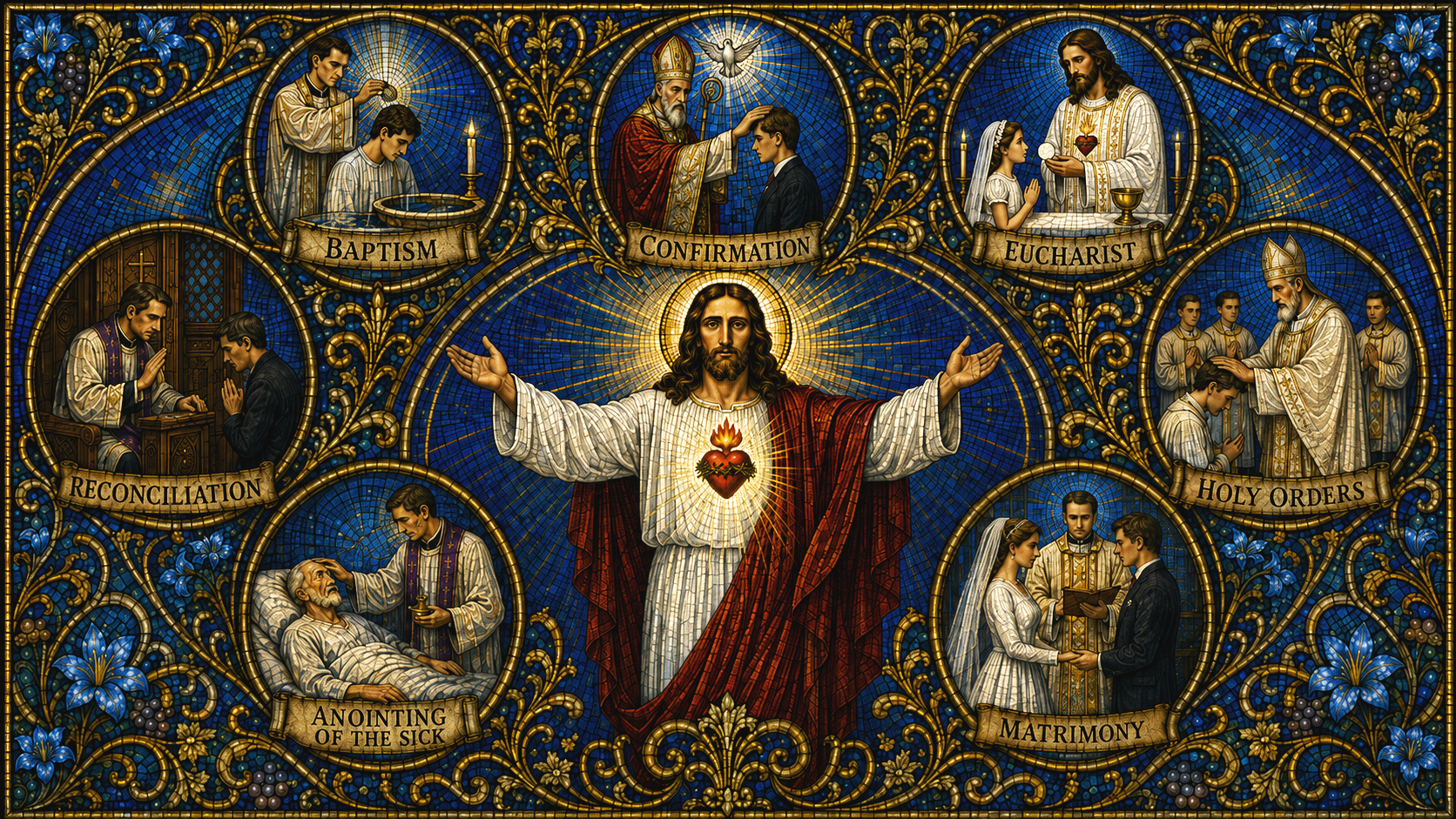
The seven sacraments are Christ’s living and saving action in His Church—efficacious signs of grace, instituted by Him and entrusted to the Church, through which the divine life is communicated to us. Rooted in the Paschal Mystery of the Lord’s Death and Resurrection, they accompany every decisive stage of Christian life: giving us new birth and growth, bringing forgiveness and healing, and consecrating us for communion and mission. In each sacrament, the risen Christ comes personally to meet His people through visible signs and the power of the Holy Spirit, healing and transforming those who receive Him and conforming them ever more deeply to Himself. In the spirit of St. John Paul II, the sacramental life is not a collection of isolated religious ceremonies, but a continual encounter with the living Christ—a path by which the human person discovers the greatness of his or her vocation, is formed in the sincere gift of self, and is sent forth to build a civilization of love. We are therefore invited to approach the sacraments frequently, consciously, and with hearts open to conversion, trusting that Christ desires through them to make us holy, strengthen the communion of His Church, and form us into joyful witnesses of His saving love. (CCC 1113–1131, 1210).
-
In Baptism, the Father calls us out of darkness and gives us the radical newness of Christian life in His Son. Through water and the Holy Spirit, we are freed from sin, reborn as a “new creation,” made adopted children of God, incorporated into Christ and His Church, and consecrated as temples of the Holy Spirit. Baptism also imprints an indelible spiritual seal, marking us forever as belonging to Christ. This sacrament is therefore not simply a beautiful moment from our past; it is the foundation of our identity and vocation. As St. John Paul II taught, the baptized are “children in the Son,” called to live their dignity through holiness, communion, and mission. Each day becomes an invitation to renew our baptismal promises, resist sin, and allow the life of Christ to shine through us. (CCC 1213, 1262–1270; Christifideles Laici, 10–14).
Interested in receiving Baptism?
Baptism Application
“He continues to be Love that searches for us … and to elevate us to the dignity of children of God.”
—Mother Adela Galindo, SCTJM Foundress -
The Eucharist is the source and summit of the Christian life, the sacrament toward which all the other sacraments are ordered. At every Mass, the one sacrifice of Christ on Calvary is made sacramentally present, and the Risen Lord gives us His true Body and Blood as the food of eternal life. The Eucharist is at once sacrifice, memorial, sacred banquet, and abiding presence. By receiving Christ worthily, we are united more intimately to Him, strengthened against sin, and drawn more deeply into the communion of His Mystical Body, the Church. St. John Paul II taught that the Eucharist must be lived in its fullness—in the celebration of Mass, in Holy Communion, and in loving adoration. Before the Eucharistic Heart of Jesus, we are gradually transformed into what we receive and sent forth to become a sincere gift for others. (CCC 1322–1327, 1362–1381, 1391–1401; Ecclesia de Eucharistia*, 10, 12–16, 25).
We invite you to join us for the Holy Mass and to pray in our Adoration Chapel.
“Where are the saints formed? In the same place where you are: before the presence of Jesus in the Eucharist.”
—Mother Adela Galindo, SCTJM Foundress -
Confirmation completes baptismal grace and gives us a special outpouring of the Holy Spirit, as the Apostles received at Pentecost. Through sacred chrism and the laying on of hands, we are rooted more deeply in divine filiation, united more firmly to Christ, strengthened in our bond with the Church, and associated more closely with her mission. The Spirit marks us with an indelible seal and gives us the courage to spread and defend the faith through both words and deeds. Confirmation is not a graduation from religious formation, but a personal Pentecost and a commissioning for mission. In the language of St. John Paul II, the confirmed Christian is called to become a courageous witness of Christ and an active participant in the New Evangelization—bringing the Gospel into families, workplaces, schools, communities, and every area of human life. (CCC 1285, 1294–1296, 1302–1305, 1316).
“The hour has come so that, testifying with the power of the Holy Spirit, we may go forward to the New Evangelization.”
—Mother Adela Galindo, SCTJM Foundress -
In the Sacrament of Reconciliation, the crucified and risen Christ welcomes the sinner into the merciful embrace of the Father. Those who approach this sacrament with contrition receive pardon for sins committed after Baptism and are reconciled both with God and with the Church, whose communion sin has wounded. Through the ministry of the priest, Christ Himself judges with truth, heals with compassion, and restores the penitent to grace. Our sincere repentance, confession, absolution, and willingness to make satisfaction open the heart to a genuine conversion of life. St. John Paul II emphasized that reconciliation with God also begins to heal the divisions caused by sin within ourselves, our families, the Church, and society. We should therefore approach Confession not with fear, but with confidence: the Lord desires not to condemn the repentant heart, but to restore its freedom, dignity, peace, and capacity to love. (CCC 1422–1424, 1440–1449, 1450–1460, 1468–1470; Reconciliatio et Paenitentia*, 31).
Confession times:
Saturday: 4:00pm-4:45pm
Sunday: 11:00am - 11:45am & 5:00pm-5:45pm
“A contrite heart… is the necessary foundation for a life of holiness.”
—Mother Adela Galindo, SCTJM Foundress -
In the Anointing of the Sick, Jesus, the Divine Physician, comes close to those experiencing serious illness, the frailty of old age, or a grave decline in health. Through the prayer of the priest and anointing with blessed oil, the whole Church commends the sick person to the suffering and glorified Lord. The sacrament gives the special grace of union with Christ’s Passion, strength, peace, and courage; it brings forgiveness of sins when sacramental confession is not possible, may restore bodily health when this serves salvation, and prepares the person for the final journey to the Father. St. John Paul II taught that suffering, when freely united to Christ, is not meaningless or spiritually barren. Without denying its pain, Christ transforms it from within, allowing the sick person to participate mysteriously in His redemptive love and to contribute to the good of the entire Church. (CCC 1499–1515, 1520–1523, 1532; Salvifici Doloris*, 19, 23–27).
If you or a loved one are in need of the sacrament of Anointing of the Sick, please call the parish office for more information: (305) 446-2427
“If only we would understand the power of suffering in the light of the Cross of Our Lord!”
—Mother Adela Galindo, SCTJM Foundress -
Holy Orders is the sacrament through which Christ’s apostolic mission continues in the Church through the ministries of bishops, priests, and deacons. By the laying on of hands and the consecratory prayer, the Holy Spirit confers a sacred and permanent gift. Bishops and priests are configured to Christ as Priest, Teacher, Head, and Shepherd, while deacons are strengthened to serve the People of God through the ministry of the word, the liturgy, and charity. This configuration is not a privilege of worldly status, but a call to pastoral charity and self-emptying service. In the language of St. John Paul II, the ordained minister is called to prolong the presence of Christ the Good Shepherd, making His merciful and saving love visible among the flock. Holy Orders is truly a gift and mystery: a divine election received humbly and fulfilled through prayer, fidelity, sacrifice, and the total gift of oneself for the salvation of others. (CCC 1536, 1548–1553, 1562–1571, 1581–1589; Pastores Dabo Vobis*, 12–18).
“You have been chosen by God … to a participation in His priestly heart, life and mission.”
—Mother Adela Galindo, SCTJM Foundress -
In Holy Matrimony, a baptized man and woman freely establish a covenant and partnership of their whole lives, ordered by God toward the good of the spouses and the procreation and education of children. Through their consent, husband and wife mutually and definitively give themselves to one another, and Christ elevates their covenant to a sacrament of His faithful and fruitful love for the Church. The grace of Matrimony perfects their human love, strengthens their indissoluble unity, and sanctifies them on their journey toward eternal life. St. John Paul II taught that spouses discover their dignity through the sincere gift of self: learning, day by day, to forgive, serve, sacrifice, remain faithful, and welcome life. Their family becomes a domestic church, a school of prayer and love, and the heart of a new civilization in which each person is received as a gift. (CCC 1601–1605, 1612–1617, 1625–1632, 1638–1658, 1661–1666; Familiaris Consortio*, 11, 17–21, 49–64).*
“Marriage and family are a school—where persons learn to love and where their hearts can be shaped for love.”
—Mother Adela Galindo, SCTJM Foundress
“Teach us to walk the path of authentic discipleship … frequently receiving his grace and power in the sacraments.”
—Mother Adela Galindo, SCTJM Foundress